


We all need to ensure online safety
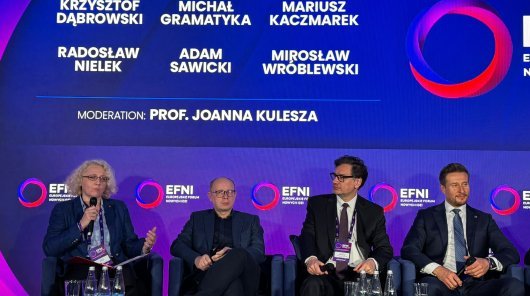
Digital threats are evolving faster than our ability to detect and neutralize them. Data breaches and phishing. Disinformation, manipulation, and deepfakes—these were the topics of a discussion titled “Threats That Never Sleep: Online Security Is a Shared Responsibility,” in which Mirosław Wróblewski, President of the Personal Data Protection Office (UODO), participated during the European Forum for New Ideas.
The main topics of the discussion held on October 16 concerned the division of responsibility among the government, businesses, and users. The discussion focused on regulatory consistency (GDPR, NIS2, the Artificial Intelligence Act, DSA/DMA) and—something that seems to be an increasing problem for all of us—trust in online content.
Mirosław Wróblewski, President of the Personal Data Protection Office, noted that the risk-based regulatory model adopted in the GDPR has proven effective as the foundation of the European personal data protection system. This is because it allows the obligations of data controllers to be tailored to the actual scale of risks, rather than imposing identical solutions on all entities.
„We find a similar approach in the NIS2 Directive, which requires certain entities to implement proportionate cybersecurity risk management measures, and in the Artificial Intelligence Act, which differentiates requirements based on risk category and the type of AI system. The risk-based approach has thus become one of the fundamental mechanisms of European digital legislation,” explained Mirosław Wróblewski.
Mirosław Wróblewski also pointed out that digital security should be viewed as a shared responsibility among the state, businesses, and users. This does not mean, however, that all these entities bear the same burden of responsibility.
“We cannot expect the average citizen to have the same level of knowledge and ability to respond to threats as professional digital service providers. In particular, it should be unacceptable to shift the responsibility for poorly designed or inadequately secured systems onto the user,” he added.
The panel also included:
• Krzysztof Dąbrowski, Managing Director of the Security Division at the UKNF
• Michał Gramatyka, Secretary of State at the Ministry of Digital Affairs
• Mariusz Kaczmarek, Managing Director of the Digital Transformation Division, Totalizator Sportowy
• Radosław Nielek, Director, NASK
• Adam Sawicki, Group Senior Vice President – Digital, TVN Warner Bros. Discovery
All of them discussed how to build a system in which responsibility for digital security is shared—among users, businesses, and public administration.